
Ducks and geese are both aquatic birds belonging to the family Anatidae. They frequently inhabit the same environments, such as lakes, rivers, and ponds. Despite their similarities, they are distinct animals with unique behaviors, physical characteristics, and life cycles. This article provides a detailed comparison of the key differences between the two to assist with correct identification.
Physical Size and Neck Length
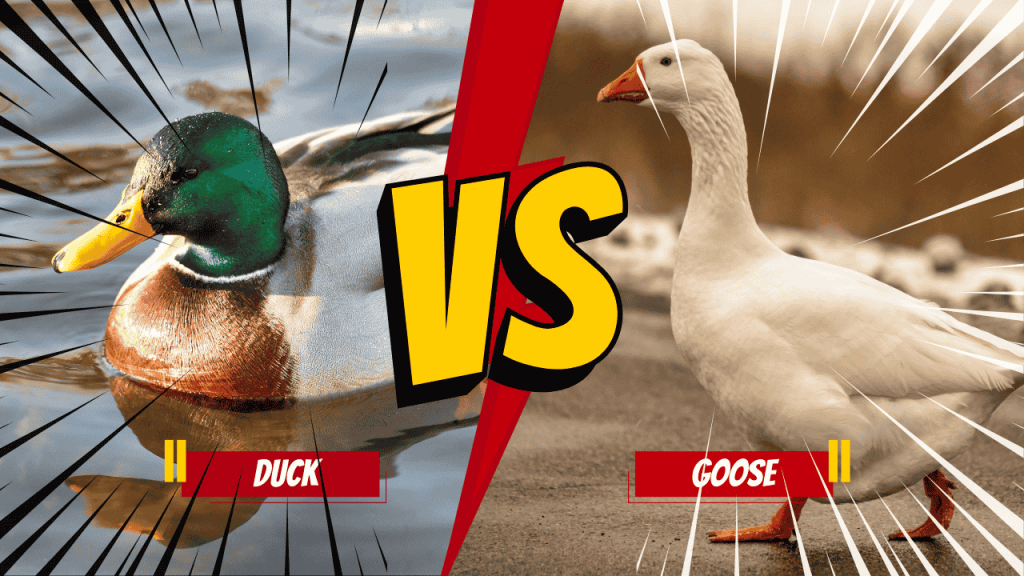
The most immediate differences are the general body size and the structure of the neck.
Geese: Geese are medium to large birds, significantly heavier and larger than ducks. Their most defining feature is the neck; geese possess long, elongated necks. This length allows them to reach food deep underwater or graze on tall grass while keeping their heads elevated to scan for predators. When standing, they appear tall and elegant.
Ducks: Ducks are generally smaller birds with compact, stout bodies. Their necks are much shorter compared to geese. Due to the short neck and round body, they appear to sit lower in the water. They look stockier and less upright than geese.
Color and Plumage (Sexual Dimorphism)
Plumage is one of the most reliable methods for identification, particularly during the breeding season.
Geese: Male and female geese typically appear identical. They are sexually “monomorphic.” Both the male (gander) and the female (goose) share the same feather colors and patterns. It is difficult to determine their gender based solely on visual appearance. Their plumage usually consists of grey, white, brown, or black tones to blend in with their surroundings.
Ducks: Most ducks are sexually “dimorphic,” meaning the male and female look very different. The male duck (drake) often displays bright, colorful feathers—such as green heads or blue wing patches—to attract a mate. The female duck (hen) usually has dull brown or grey plumage to remain camouflaged while nesting.
Beak Shape and Diet
Their beaks (bills) are specialized tools evolved for their specific dietary needs.
Geese: Geese are primarily herbivores and grazers. Their bill is shorter, narrower, and deeper at the base, shaped somewhat like a wedge. Inside the bill, they possess sharp, serrated edges called “tomia” that function like small teeth. They use these to shear tough grass and grains on land. They feed less frequently in the water compared to ducks.
Ducks: Ducks are omnivores. Their bill is longer, wider, and flat, resembling a spatula. It is designed for “dabbing” or filtering. They take a mouthful of water and expel it through comb-like structures on the side of the beak to trap insects, snails, and aquatic plants. They lack the strong cutting power of a goose’s beak.
Legs and Walking Ability
The anatomical positioning of the legs affects their movement on land.
Geese: Their legs are positioned centrally under their bodies. This center of gravity allows them to walk comfortably for long distances and run quickly if threatened. Consequently, geese are often observed foraging in fields or parks far from the water’s edge.
Ducks: Their legs are set far back on the body, near the tail. This position acts like a propeller, making them powerful and efficient swimmers. However, this placement makes them unstable on land. To maintain balance, they must walk with a side-to-side motion known as a “waddle.” They are generally slow and clumsy on the ground.
Sounds and Communication
The vocalizations they produce are distinct and easily recognizable.
Geese: Geese are very vocal and loud. Their primary call is a “honk,” which is a deep, resonant sound. They often honk while flying in formation to communicate with the flock. Both males and females produce similar loud calls.
Ducks: Ducks produce a wider variety of sounds, but they are generally quieter than geese. The famous “quack” is actually produced only by the female of certain species (such as the Mallard). Male ducks often make softer sounds, including whistles, rasps, or low grunts. They do not honk.
Social Habits and Pairing
Their approach to reproduction and family structure differs significantly.
Geese: Geese are known for long-term pair bonding. They are monogamous and typically pair for life. If a mate dies, the remaining goose may mourn for a significant period before finding a new partner. Both parents actively help raise the young (goslings) and protect them aggressively.
Ducks: Ducks are serially monogamous. They usually pair up for only a single breeding season. Once the female lays the eggs, the male often departs and plays no role in raising the offspring (ducklings). The female raises the brood alone.
Comparison Summary Table
| Feature | Goose | Duck |
|---|---|---|
| Scientific Subfamily | Anserinae | Anatinae |
| Size | Large / Heavy | Small / Compact |
| Neck | Long and slender | Short and thick |
| Colors | Male & Female look identical | Male is colorful, Female is dull |
| Beak | Short, strong, serrated | Flat, wide, spoon-shaped |
| Leg Position | Central (Walks well) | Back (Waddles) |
| Diet | Mostly vegetarian (Grass) | Omnivore (Insects/Plants) |
| Pairing | Pairs for life | Seasonal pairs |
| Sound | Loud “Honk” | “Quack” / Whistle |
Conclusion
While they share the same aquatic habitats, ducks and geese are unique animals. Geese are larger, long-necked grazers that mate for life and communicate with loud honks. Ducks are smaller, colorful swimmers that waddle on land and communicate through quacks and whistles. Observing the neck length and plumage differences provides the most accurate way to distinguish between them in the wild.


