
Have you ever looked closely at a pigeon strutting across the sidewalk, or a chicken pecking in the dirt, and thought they looked slightly… prehistoric? If you’ve ever wondered, “Are birds dinosaurs?” you are not alone. It is one of the most fascinating questions in natural history, and the answer completely changes how we view the animal kingdom.
The short answer is: Yes, birds are dinosaurs.
They aren’t just related to dinosaurs; they are literal, living dinosaurs that survived the mass extinction 66 million years ago.
In this comprehensive guide, we are going to dive deep into the evolutionary family tree, uncover the undeniable scientific evidence that links your backyard blue jay to a Tyrannosaurus rex, and look at the modern birds that still act exactly like their ancient ancestors.
The Short Answer: Yes, Birds Are Literal Dinosaurs
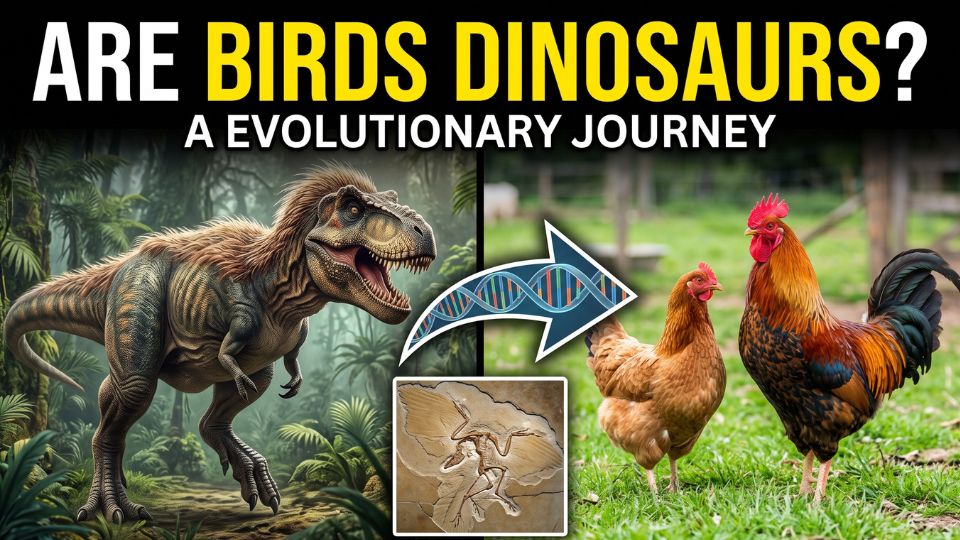
To understand how a tiny hummingbird can be a dinosaur, we have to rethink what the word “dinosaur” actually means.
When most of us hear the word, we picture giant, scaly monsters like the Stegosaurus or the Brachiosaurus. But scientifically speaking, “Dinosauria” is simply a specific group (or clade) of animals that share a common ancestor and specific anatomical traits.
Paleontologists divide dinosaurs into two main categories:
- Non-avian dinosaurs: This includes all the famous extinct species like Triceratops, Spinosaurus, and T. rex.
- Avian dinosaurs: This is the group that includes all modern birds.
So, asking if birds are dinosaurs is scientifically the same as asking if bats are mammals or if snakes are reptiles. Birds are the only surviving branch of the dinosaur family tree.
Unraveling the Dinosaur Family Tree: How Birds Fit In
To understand the bird-dinosaur connection, we have to travel back over 150 million years and look at the dinosaur family tree.
1. The Great Divide: “Lizard-Hipped” vs. “Bird-Hipped”
Early in their evolution, dinosaurs split into two major groups based on their pelvic structure: the Ornithischians (“bird-hipped”) and the Saurischians (“lizard-hipped”).
In one of science’s greatest ironic twists, birds did not evolve from the “bird-hipped” dinosaurs (like Triceratops). Instead, birds evolved from the “lizard-hipped” Saurischians. Over millions of years, the hips of one specific Saurischian lineage evolved to look like modern bird hips through convergent evolution.
2. Theropods: The Meat-Eating Ancestors
Within the Saurischian group was a diverse sub-group of bipedal (two-legged) dinosaurs called Theropods. This group contained all the famous meat-eaters, including the Tyrannosaurus rex and the Velociraptor.
3. Coelurosaurs and Maniraptorans
As theropods continued to evolve and diversify, a smaller, more agile sub-group emerged called Coelurosaurs, which eventually gave rise to the Maniraptorans (meaning “hand snatchers”). It is within this specific, feathered group of agile predators that the very first true birds (Avialae) took flight during the Jurassic period.
The Smoking Gun: Scientific Evidence Linking Birds and Dinosaurs
The claim that birds are dinosaurs isn’t just a wild theory; it is backed by mountains of fossilized and biological evidence. Here are the undeniable biological links between modern birds and extinct theropods.
1. Feathers Came Before Flight
For a long time, scientists believed feathers were unique to birds and evolved specifically for flight. Fossil discoveries in the 1990s, particularly in the Liaoning province of China, changed everything.
Paleontologists discovered dozens of non-avian dinosaur fossils preserved with clear impressions of feathers. We now know that famous dinosaurs like Velociraptor were covered in feathers, not scales! Because these early dinosaurs couldn’t fly, scientists believe feathers originally evolved for insulation (warmth) and colorful mating displays, much like a modern peacock.
2. The Skeletal Connection
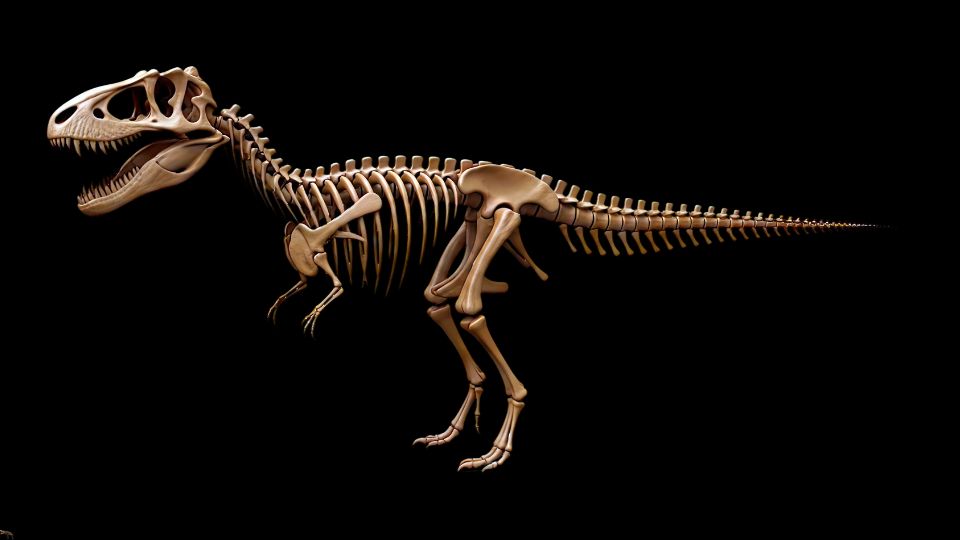
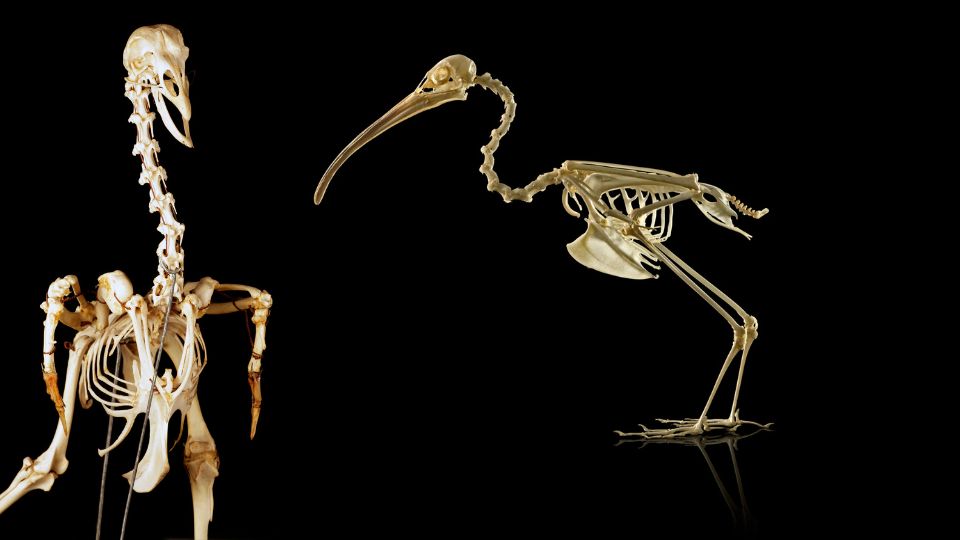
If you place the skeleton of a chicken next to the skeleton of a small theropod dinosaur, the similarities are staggering.
- The Wishbone (Furcula): Dinosaurs like T. rex and Allosaurus possessed a fused collarbone, identical to the wishbone you find in a Thanksgiving turkey.
- Hollow Bones: To be large but fast, theropod dinosaurs evolved pneumatized (hollow) bones. Birds inherited these lightweight, honeycombed bones, which eventually became crucial for the mechanics of flight.
- The Wrists: Birds can fold their wings flat against their bodies thanks to a specialized half-moon-shaped bone in their wrists called a semilunate carpal. Paleontologists have found this exact same bone in the wrists of raptor dinosaurs, who likely used it to snatch and grapple prey.
- Three-Toed Feet: Look at the footprints left behind by a T. rex and compare them to the footprints of an emu. The three-toed, clawed structure is nearly identical.
3. Supercharged Lungs
Birds have an incredibly efficient respiratory system. Unlike mammals, which breathe air in and out of the same airway, birds have a system of “air sacs” that allows air to flow in only one continuous direction through their lungs. This unidirectional breathing provides constant oxygen, which is necessary for the extreme energy demands of flight.
Fossilized theropod bones show the exact same hollow pockets where these air sacs would have been attached, proving that dinosaurs breathed just like modern birds.
4. Eggs, Nests, and Brooding
Both birds and dinosaurs lay hard-shelled, amniotic eggs made of calcium carbonate. Furthermore, fossil evidence shows that dinosaurs built circular nests on the ground and sat on their eggs to incubate them (a behavior called brooding), exactly as modern birds do.
Archaeopteryx: The Famous “Missing Link”
You cannot discuss the evolution of birds without mentioning Archaeopteryx. Discovered in Germany in 1861, just two years after Charles Darwin published On the Origin of Species, this fossil was the ultimate “missing link.”
Living about 150 million years ago, Archaeopteryx was a perfect transitional fossil. It possessed classic dinosaur features:
- A long, bony tail
- Sharp teeth in its jaws
- Claws on its fingers
But it also had distinct bird features:
- Fully developed flight feathers
- A wishbone
- Wings
Archaeopteryx proved once and for all that the line between “dinosaur” and “bird” was incredibly blurred.
The Great Extinction: Why Did Birds Survive While the T. Rex Died?
Approximately 66 million years ago, an asteroid the size of Mount Everest slammed into the Earth, triggering the Cretaceous-Paleogene (K-Pg) mass extinction event. This wiped out roughly 75% of all life on Earth, including all non-avian dinosaurs.
So, if birds are dinosaurs, how did they survive the apocalypse?
While we can’t know for sure, scientists point to a few key survival advantages that early birds possessed:
- Small Size: The asteroid strike destroyed global food chains, killing off massive plants and the giant herbivores that ate them (which in turn starved the giant carnivores). Early birds were small, meaning they required far less food and calories to survive the “impact winter.”
- Dietary Adaptability: Many early birds had already evolved toothless beaks that were excellent for cracking open seeds and nuts. While fresh meat and vegetation were scarce, the ground was littered with seeds, providing a reliable food source.
- Mobility: The ability to fly allowed early birds to escape localized devastation, travel long distances to find shrinking food sources, and seek out the few remaining habitable environments.
Meet the Living Dinosaurs: 4 Modern Birds That Still Look Prehistoric
While a fluffy chickadee might not strike fear into your heart, there are several modern birds that will immediately remind you of their apex-predator ancestors.
1. The Southern Cassowary
Often called the “world’s most dangerous bird,” the cassowary is a massive, flightless bird native to Australia and New Guinea. With its brightly colored neck, booming, low-frequency vocalizations, and a large bony helmet (casque) on its head, it looks straight out of Jurassic Park. More terrifyingly, it possesses a 4-inch, dagger-like claw on its inner toes, which it uses to defend itself—just like a Velociraptor.
2. The Shoebill Stork
Standing up to 5 feet tall in the swamps of East Africa, the Shoebill is a massive bird with a chilling, predatory stare. Its enormous, powerful beak is shaped like a wooden shoe and features a razor-sharp hook at the end, which it uses to decapitate lungfish and even baby crocodiles.
3. Ostriches and Emus
These large flightless birds (Ratites) are perhaps the best visual representations of what small, bipedal theropod dinosaurs looked like when they ran. Their powerful legs, scaly feet, and upright posture are a direct echo of their evolutionary past.
4. The Humble Chicken
It has become a popular internet meme, but it is scientifically accurate: the chicken is one of the closest living relatives to the Tyrannosaurus rex. In 2003, scientists managed to extract preserved collagen proteins from a 68-million-year-old T. rex femur. When they analyzed the protein sequencing, they found it most closely matched the genetic makeup of the modern domestic chicken and the ostrich.
Debunking Common Myths About Birds and Dinosaurs
To fully understand this topic, we need to clear up some persistent misconceptions.
Myth 1: “Dinosaurs went completely extinct 66 million years ago.” Fact: Only the non-avian dinosaurs went extinct. The avian dinosaurs (birds) survived, adapted, and thrived. Today, there are roughly 10,000 species of dinosaurs (birds) living on Earth, making them more diverse than mammals!
Myth 2: “Pterodactyls are the ancestors of birds.” Fact: Pterosaurs (including Pterodactyls) were flying reptiles that lived alongside dinosaurs, but they were not dinosaurs themselves, and they are not related to birds. They completely died out during the mass extinction. Birds evolved flight entirely independently of Pterosaurs.
Myth 3: “Reptiles like crocodiles and lizards are closer to dinosaurs than birds.” Fact: Crocodiles are closely related to dinosaurs (they both belong to a larger group called Archosaurs), but they are essentially cousins. Birds are not cousins to dinosaurs; they are dinosaurs.
Conclusion: Look Out Your Window to See a Dinosaur
The realization that birds are dinosaurs requires a massive shift in how we view the natural world. Dinosaurs didn’t fail; they didn’t all die out. They adapted, they grew feathers, they learned to fly, and they conquered the skies.
The next time you are eating chicken nuggets, listening to a robin sing in the morning, or watching a hawk circle overhead, take a moment to appreciate the incredible 150-million-year evolutionary journey of the animal you are looking at. The Age of Dinosaurs never really ended—it just took flight.
Frequently Asked Questions (FAQs)
Are birds reptiles? Technically, yes. Because birds evolved from theropod dinosaurs, and dinosaurs are nested within the larger reptile family tree (Reptilia), cladistics (the system of classifying organisms based on ancestry) dictates that birds are technically highly-evolved reptiles.
Did a T. Rex have feathers? While we haven’t found a T. rex fossil completely covered in feathers, scientists have found extensive feathering on close relatives of the T. rex (like the Yutyrannus). Most paleontologists currently agree that T. rex likely had at least some feathers, perhaps a sparse covering like the hair on an elephant, especially when they were babies.
Is a crocodile a dinosaur? No. Crocodiles and alligators belong to a group called Crocodilia. They share a very ancient common ancestor with dinosaurs (making them Archosaurs), but they branched off on their own evolutionary path millions of years before true dinosaurs existed.
What was the first bird? Archaeopteryx is generally considered the first true bird (or Avialan), living around 150 million years ago. However, the exact line where a feathered dinosaur becomes a “bird” is highly debated among paleontologists because the evolutionary transition was so gradual.


