
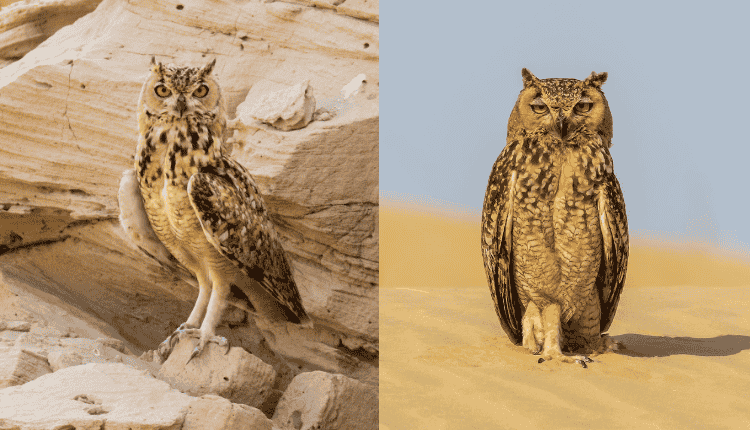
The Pharaoh Eagle Owl (Bubo ascalaphus) is a striking desert owl known for its sandy-colored plumage, large ear tufts, and bright orange eyes. It thrives across North Africa, the Sahara, and parts of the Middle East places where few large raptors manage to survive. This species has adapted perfectly to harsh, dry environments, using camouflage, patience, and silent flight to hunt in some of the world’s most extreme landscapes.
In desert ecosystems, the Pharaoh Eagle Owl plays an essential role as a top predator. It helps keep populations of rodents, reptiles, and small birds in balance, which is especially important in fragile habitats where small changes can quickly disrupt the entire ecological chain.
Quick facts: This owl measures 46–55 cm in length, has a wingspan of 110–138 cm, and is currently listed as Least Concern by the IUCN—although local threats such as habitat loss and climate change remain relevant.
Scientific Classification
The scientific name of the Pharaoh Eagle Owl is Bubo ascalaphus, first described by Savigny in 1809. It belongs to the family Strigidae, the “true owls,” which includes many large nocturnal species with strong talons, hooked bills, and forward-facing eyes adapted for hunting at night.
Within the eagle owl group, it is closely related to species such as the Spotted Eagle Owl (Bubo africanus) and the Eurasian Eagle Owl (Bubo bubo). While it shares a similar shape and appearance with the Eurasian Eagle Owl, there are clear differences: Pharaoh Eagle Owls are smaller, paler, and adapted for hot, arid habitats, whereas the Eurasian species is larger, darker, and found in forests and mountains. These distinctions are important for birders and researchers, especially in overlapping regions like North Africa where misidentification can occur.
Subspecies Differences
The Pharaoh Eagle Owl includes two recognized subspecies, each adapted to different parts of North Africa and the Arabian deserts. Although often overlooked online, these differences are important for birders—and give your article a strong SEO advantage.
Bubo ascalaphus ascalaphus occurs across northern regions such as Morocco, Algeria, Libya, and Egypt. It is generally larger, with richer buff tones and stronger streaking across the body.
Bubo ascalaphus desertorum is found deeper into the Sahara and Middle Eastern deserts. It is smaller and much paler, often appearing almost beige. The lighter coloration helps it blend with very open, sandy habitats.
Key differences for quick comparison:
- ascalaphus: larger
- desertorum: smaller
- ascalaphus: more strongly marked
- desertorum: paler overall
- ascalaphus: often linked to rocky desert regions
- desertorum: more common in open sandy landscapes
Distribution and Habitat
The Pharaoh Eagle Owl has a wide desert-range that stretches across North Africa, from Morocco and Algeria to Libya and Egypt. Its distribution continues eastward through the Middle East, including Israel, Jordan, and Syria, and extends into the Arabian Peninsula, where it is found in Saudi Arabia, Oman, and the UAE. Smaller populations also occur in parts of Western Asia, making it one of the most widespread desert owls.
Across this vast region, the owl prefers habitats that combine open visibility with safe roosting spots. It thrives in rocky deserts, where cliffs and boulders provide natural nesting ledges, and it is commonly seen in wadis—dry riverbeds that attract prey species. The species also inhabits rugged cliff faces and semi-arid zones with scattered shrubs or small trees, which offer shelter and hunting opportunities.
The Pharaoh Eagle Owl is typically found from sea level up to around 2,000 meters depending on the region. In Morocco and Algeria, it often occupies hilly or rocky plateaus, while in the Arabian Peninsula it is more common in open sand deserts bordered by stony escarpments.
Even without a map, its range can be visualized as a broad belt following the southern Mediterranean coastline, cutting through the Sahara, and then bending toward the Arabian deserts. Within this range, the owl’s distribution is patchy but consistent in areas with cliffs, wadis, and enough prey to support a resident pair.
Behavior and Ecology
The Pharaoh Eagle Owl is mostly nocturnal, spending the heat of the day roosting in shaded, sheltered locations such as caves, cliff crevices, abandoned buildings, or dense palm groves. Its behavior is shaped by the desert environment: it conserves energy during the scorching daytime hours and becomes active when temperatures drop. Many of its adaptations—light plumage, efficient heat regulation, and silent flight—help it survive long, hot days and hunt effectively in low light.
This species is generally solitary, although it may be seen in pairs during the breeding season or when a male guards a territory. These territories can be quite large, especially in barren landscapes where prey is scarce. Both males and females tend to defend their space from other owls, often through vocal displays rather than physical confrontation.
The owl is an opportunistic predator with a varied diet that includes rodents, small mammals, birds, reptiles, and even large insects. In many parts of the Sahara, jerboas and gerbils make up a significant portion of its prey. It typically hunts using a classic perch-and-pounce strategy: watching quietly from a raised rock or dune, then swooping down with precision once it detects movement. Its broad wings and silent feathers allow it to approach prey almost undetected.
Daily activity patterns are strongly tied to light and temperature. The owl becomes active shortly after sunset, hunts throughout the night, and may continue into early dawn if food is abundant. During extremely hot or windy nights, it may limit activity to conserve energy, showing just how finely tuned it is to the desert’s rhythm.
Breeding and Nesting
The breeding season of the Pharaoh Eagle Owl varies depending on region, but it generally begins in late winter to early spring. In North Africa, pairs may start courtship as early as January, while populations in the Arabian Peninsula often breed slightly later, from February into April. The timing aligns with periods when prey is more abundant after winter rains.
Courtship involves soft hooting exchanges, bowing displays, and mutual preening. Males may offer food to females, reinforcing the pair bond. Once bonded, the pair chooses a nesting site—often a rocky ledge, cliff cavity, or the ground near a boulder. This species does not build a nest; instead, it uses natural depressions or scrapes. In some regions, Pharaoh Eagle Owls also take advantage of human structures, such as abandoned buildings, ruined walls, or old watchtowers.
Females typically lay a clutch of 1–3 eggs, which are incubated for about 31–36 days. The female handles nearly all incubation while the male provides food. Once hatched, the chicks are covered in white down and rely entirely on the parents. Fledging usually occurs around 35–45 days, but young owls remain dependent for weeks afterward, learning to hunt and strengthening their flight muscles. This extended parental care gives them a higher chance of survival in the harsh desert environment—something many competitor pages barely mention.
Vocalizations
The Pharaoh Eagle Owl produces a range of calls, each with a distinct purpose. Its most familiar vocalization is a deep, resonant “hoo-hoo” that carries across long desert distances. These calls help pairs communicate, especially at dawn and dusk when sound travels best. Males typically have deeper, slower hoots, while females produce slightly higher-pitched versions.
Alarm calls are sharper and more abrupt, often resembling a short bark or harsh screech. These are used to warn mates, chicks, or to deter approaching predators. The species also emits softer contact calls during courtship or when parents communicate with fledglings.
Adaptations to Desert Life
The Pharaoh Eagle Owl has evolved a suite of remarkable adaptations that allow it to thrive in environments where temperatures swing from freezing nights to scorching days. One of its most effective adaptations is its camouflage—the sandy, mottled plumage blends seamlessly with dunes, cliffs, and rocky plains, making the owl almost invisible during the day.
Water conservation is another major survival strategy. The owl gains most of its moisture from prey and rarely needs free-standing water. Its kidneys efficiently retain fluids, allowing it to live in extremely arid regions. To cope with desert heat, the owl rests in shaded areas and regulates its body temperature through panting, wing-drooping, and selecting cool microhabitats such as caves or dense palm groves.
Silent flight is essential for hunting in open terrain. The edges of its feathers are designed to reduce turbulence, allowing it to approach prey quietly even in still, moonlit conditions. Its large eyes, adapted for low light, gather every available photon, helping the owl spot movement from long distances during the night. Combined with excellent hearing, these adaptations make it a highly effective nocturnal predator perfectly built for desert life.
Conclusion
The Pharaoh Eagle Owl is one of the desert’s most impressive and least understood raptors a species perfectly shaped by the harsh landscapes it calls home. From its sandy camouflage and low-light hunting abilities to its wide range across North Africa and the Arabian Peninsula, this owl shows just how adaptable wildlife can be in extreme environments. Although it is currently listed as Least Concern, growing pressures such as habitat disturbance, climate change, and human expansion mean that continued awareness and conservation remain important.
For birdwatchers, researchers, and travelers, spotting a Pharaoh Eagle Owl in the wild is unforgettable. Its silent flight, intense orange eyes, and commanding presence at dusk capture the true spirit of desert wilderness. Whether you’re exploring rocky plateaus, wadis, or open dunes, this owl represents one of the Sahara’s most iconic and resilient species a reminder of how life thrives even where conditions seem impossible.


