
The Desert Sparrow (Passer simplex) is one of the quiet gems of the Sahara, a small and gentle bird perfectly shaped by the desert’s calm, warm light, and endless dunes. During my birdwatching tours in Merzouga, he is often one of the first birds my clients notice. He appears near old mud houses, around wells, and sometimes right at our feet, as if he is welcoming us to his desert home.
Scientifically, he belongs to the Passeridae family and is closely related to Zarudny’s Sparrow, a similar species living farther east in Central Asia. Both species show how sparrows can adapt beautifully to extreme environments. In the desert ecosystem, the Desert Sparrow plays an important role by controlling insects, scattering seeds, and bringing a gentle sense of life to even the quietest corners of the Sahara. Meeting him on a tour always feels like meeting an old friend, and for many visitors, he becomes one of the birds they remember most.
Taxonomy and Classification
The Desert Sparrow has its own special place in the bird world, even though he looks simple at first glance. Scientists classify him as follows:

| Kingdom: | Animalia |
| Phylum: | Chordata |
| Class: | Aves |
| Order: | Passeriformes |
| Family: | Passeridae |
| Genus: | Passer |
| Species: | Passer simplex |
His full scientific name is Passer simplex, first described by Lichtenstein in 1823. Over time, this name has stayed stable, although the bird’s identity has been part of a long discussion among ornithologists.
One of the main taxonomic debates involves his close cousin, Zarudny’s Sparrow (Passer zarudnyi). For many years, both birds were considered the same species because they look very similar. Later studies showed differences in their range and subtle traits, which led many experts to split them into two separate species. Even today, you may still find older books and records listing them together under older synonyms, reflecting how science slowly shapes our understanding of desert birds.
Despite the debates, the Desert Sparrow remains a unique symbol of the Sahara, and seeing him in the field always confirms how perfectly he belongs here.
Physical Description
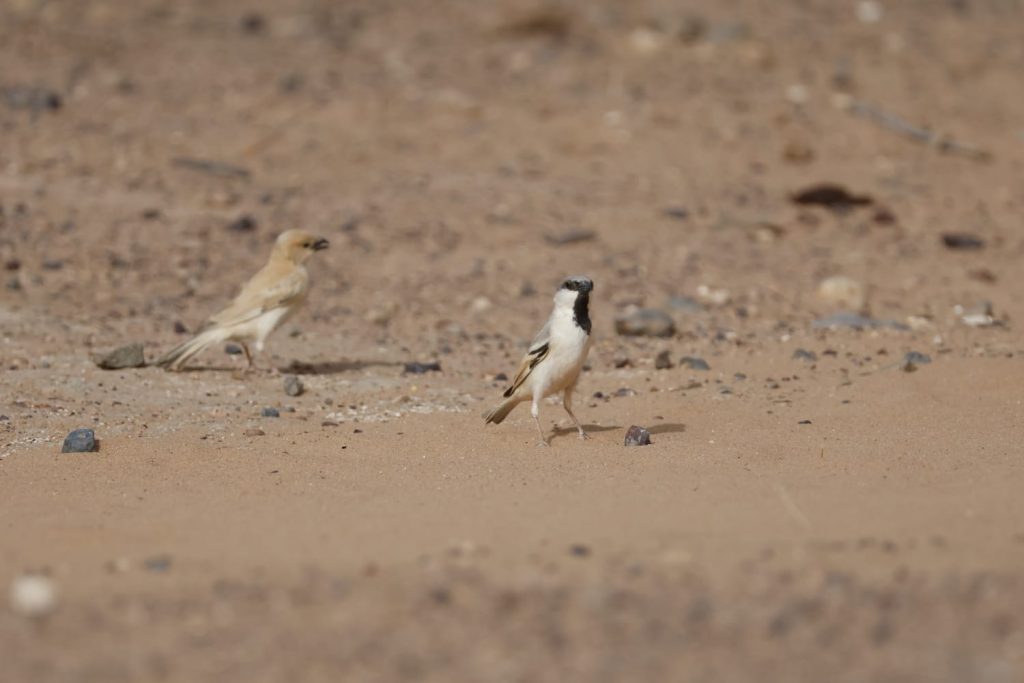
The Desert Sparrow is a small, neat bird perfectly colored for life among sand and sun. His plumage blends so well with the dunes that during our birdwatching tours, we often have trouble spotting him with the naked eye. He can be standing just a few meters away, yet his sandy colors make him almost disappear into the landscape. Many times, he only reveals himself when we play his call through a speaker; once he hears the familiar sound, he slowly comes out or approaches us, curious and alert. This behavior makes every sighting feel special, almost like he chooses the moment to appear
Males are the easiest to recognize. They wear a clear black bib under the beak, a feature that always stands out when the light hits just right. Their head is pale and clean, and the wings often show white patches that flash subtly during flight. These marks make the male Desert Sparrow look elegant without being showy.
Females, on the other hand, are quieter in appearance. They lack the black bib and have softer, more uniform sandy tones. This gentle coloring helps them stay well-camouflaged while nesting or feeding close to the ground.
Juveniles look even softer. They resemble the females but with a slightly fluffier look and very faint markings. When they hop near houses or wells, they often appear curious and calm, following adults closely.
Overall, the Desert Sparrow’s mix of sandy underparts, pale head, and in males—those distinct black and white touches, make him a bird that is easy to identify once you’ve seen him a few times, especially during birdwatching walks in the Sahara.
Subspecies:
The Desert Sparrow is divided into two recognized subspecies, each shaped by the part of the Sahara they call home. Although they look very similar, their ranges help birdwatchers understand where each one is most likely to be found.
P. s. simplex
This is the “classic” Desert Sparrow found across the central and eastern Sahara. Its range stretches through countries like Algeria, Libya, Egypt, and into parts of Sudan. In these areas, the bird lives around remote desert villages, oases, and quiet sandy plains, blending perfectly with the warm tones of the environment.
P. s. saharae
This subspecies lives in the western Sahara, including Morocco, Western Sahara, Mauritania, and parts of southern Algeria. This is the form we observe most often during our birdwatching tours in Merzouga. It shares the same gentle behavior and sandy plumage but is simply tied to its own part of the desert.
Both subspecies show how the Desert Sparrow has adapted beautifully to the vastness of the Sahara, each one fitting naturally into the landscapes they inhabit.
Distribution and Habitat
The Desert Sparrow is truly a bird of the Sahara. Its range stretches across North Africa, covering some of the driest and most open landscapes on the continent. From Morocco and Western Sahara to Algeria, Libya, Egypt, Mauritania, and parts of Sudan, this bird follows the rhythm of sand, silence, and scattered human settlements. If you look at a range map, you’ll see a wide belt across the Sahara where small pockets of suitable habitat allow the species to thrive.
The bird prefers simple, quiet places like sand dunes, open scrub, and especially areas near oases where a little shade and water create ideal conditions for feeding and nesting. It is also commonly seen around tamarisk groves, old mud houses, wells, and traditional desert villages. These spots give the Desert Sparrow shelter from heat and predators, while still providing the open space he loves.
In terms of altitude, the bird mostly stays in lowland desert zones, usually from sea level up to around 1,500 meters. This range covers most of the Sahara’s natural landscapes, allowing the sparrow to remain close to the warm, dry environments it knows so well.
Behavior and Ecology
The Desert Sparrow has a calm and gentle way of living, and much of his behavior is closely linked to the people and the landscapes of the Sahara. He often stays near small human settlements, especially traditional mud houses and oases, where he finds shelter and a steady source of food. Growing up, our fathers used to tell us that the Desert Sparrow never appears in places where other birds that live in towns or cities are common. At the time, it felt like just another story from the elders, but during my birdwatching tours, I’ve realized how true this is. The Desert Sparrow prefers quiet, open desert spaces, far from the crowded birdlife of urban areas. This behavior makes encounters with him feel more special and authentic.
When it comes to feeding, the Desert Sparrow enjoys a simple diet made of seeds, small insects, and whatever tiny desert plants and scraps he can find. Around villages, he often picks food from the ground near wells or shaded corners, showing how well he has adapted to living close to people without depending too heavily on them.
In terms of movement, he is not fully territorial, but he is not nomadic either. He tends to stay within familiar areas, especially places where he knows he can nest safely. You may see him flying short distances between dunes and houses, but he rarely travels far.
The breeding season usually begins in spring, when temperatures become mild. Courtship is simple and gentle: males show off their black bibs, sing softly, and perch in visible spots to attract a partner. Nests are typically built in small cavities, cracks in old walls, or within tamarisk trees, where the pair raises their young quietly away from disturbance.
Vocalization
The Desert Sparrow has a soft and friendly voice, usually expressed with a simple “churp” that carries gently across the dunes. It’s not a loud call, but once you learn it, you recognize it instantly during tours. The male tends to call more often, especially when he is perched on a small bush or a low roof near a village. Females call too, but their voices are softer and used mostly for close communication with the male or their young.
These calls play an important role in desert life. The sparrow uses them to keep in touch with its partner, to warn lightly when a stranger approaches, or simply to show presence in its small territory. During breeding season, the male’s chirps become a bit more frequent, helping him connect with his mate and mark the area around their nesting spot. Even in large open spaces, this gentle sound feels like a reminder that the desert is never truly silent.
Cultural Significance
The Desert Sparrow holds a special place in the hearts of Berber and Tuareg communities. For generations, people of the Sahara have seen this little bird as a symbol of peace and good luck. In many villages, elders say that the Desert Sparrow brings good news when it appears near the house or sings close to the door. These small beliefs travel from one generation to the next, becoming part of the culture and daily life of desert families.
You will also notice its presence in traditional architecture. Many old mud houses have small holes left intentionally in the walls to allow the Desert Sparrow to nest safely. People believed that welcoming these birds brought blessings to the home. Even today, during my tours, we often see nests tucked inside these tiny openings, showing how the relationship between humans and the Desert Sparrow has remained strong for centuries.
Conclusion
The Desert Sparrow may look small and simple, but he carries a deep story of the Sahara in his feathers. From his gentle “churp” to the way he appears suddenly during our tours when he hears his own call, this bird represents the quiet beauty of desert life. He has lived beside Berber and Tuareg families for centuries, nesting in old mud walls and becoming part of their traditions and beliefs. Even today, these connections continue to remind us how closely people and wildlife are linked in the Sahara.
Although the species is still considered secure, the Desert Sparrow depends on us to keep his world alive traditional buildings, healthy oases, and open landscapes where he can continue to thrive. Every time we see him during a birdwatching tour, it feels like meeting an old friend who has learned to trust the desert and the people living in it. Protecting this little bird means preserving a piece of the Sahara’s heart for future generations.
If you’re passionate about birdwatching or planning a trip to Merzouga, we’d love to guide you through this unforgettable experience.
Contact us to join our local birdwatching tours and explore the desert’s avian treasures or visit our home page to see what birds are available in Merzouga desert.


