
The cream-colored courser (Cursorius cursor) is a slender, long-legged desert bird known for its elegant shape and effortless movement across open, sandy landscapes. Its soft sandy-buff plumage blends perfectly with dry habitats, making it both beautiful and surprisingly hard to spot at first glance. With its sleek profile, strong legs, and quick, darting walk, it’s a true specialist of arid environments.
What makes this bird especially unique is its incredible speed on the ground often compared to a tiny desert sprinter. Its cryptic plumage acts as natural camouflage, allowing it to disappear into the landscape with just a slight crouch. The cream-colored courser is commonly found across North Africa, the Middle East, and the Canary Islands, thriving in harsh regions where very few birds choose to live. Birdwatchers love it not only for its graceful behavior and rarity but also for the simple joy of spotting a perfectly adapted desert bird in its natural environment. It’s one of those species that turns a quiet desert moment into something unforgettable.
Identification Guide
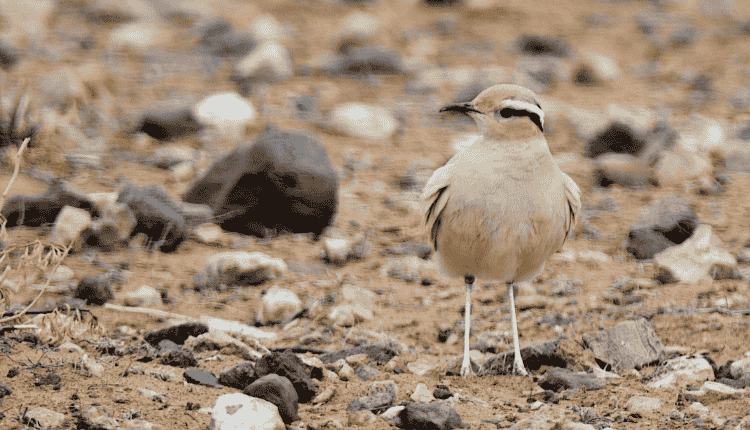
The cream-colored courser is instantly recognizable once you know what to look for. It has a slim, elegant build with long, sturdy legs that allow it to move with remarkable grace across open desert terrain. Its overall plumage is a soft creamy-buff, blending perfectly with sandy habitats and acting as natural camouflage. The head pattern is one of its most striking features: a bold dark eye-stripe running through the eye and a clean white supercilium above it, creating a sharp, contrasting facial look. Its bill is short and slightly down-curved, suited for catching insects on the ground. When seen from the front or side, the bird’s sleek posture and upright stance make it look alert and perfectly adapted to open spaces.
For birders, distinguishing the cream-colored courser from similar species—especially Temminck’s courser is key. Temminck’s has a more reddish-brown tone and a different facial pattern, while the cream-colored courser keeps a cleaner, sandier appearance with subtler contrasts. Juveniles tend to show more scaled or mottled markings on the back compared to the smoother plumage of adults, giving them a slightly “rougher” look. Males and females are generally similar, though some individuals may show faint differences in tone or brightness. In flight, the courser reveals long, pointed wings with a distinctive pattern that contrasts with the otherwise pale body, helping confirm identification even at a distance.
Subspecies
The cream-colored courser is divided into three recognized subspecies: Cream colored cursor, Cream colored bogolubovi, and Cream colored exsul, each with its own geographic range and subtle morphological differences. C. c. cursor is the most widespread, occurring across North Africa and the Middle East. It typically shows classic sandy-buff plumage and a medium overall size. C. c. bogolubovi, found from the Arabian Peninsula into parts of Southwest Asia, tends to be slightly paler and sometimes a bit larger, adapting to even more open, sun-exposed environments. C. c. exsul, restricted to the Canary Islands, is the most geographically isolated and is generally darker and richer in tone, likely an adaptation to the islands’ volcanic landscapes.
Morphologically, these subspecies differ mainly in plumage shade, overall size, and subtle variations in facial contrast. While the differences can be hard to notice in the field, birders familiar with regional populations will recognize that birds in the Arabian region tend to look paler and more elongated, while the Canary Islands form appears stockier with deeper buff tones. These variations provide valuable insight into how the species has adapted to different desert systems across its broad range—an area often overlooked by competing guides, making this section a strong value-add for readers.
Distribution and Range
The cream-colored courser has a broad but very habitat specific distribution, occupying some of the driest regions across Africa, the Middle East, and parts of South Asia. In North Africa, its range stretches from Morocco eastward through Algeria, Libya, and Egypt, continuing into Sudan. These populations are typically found in gravel plains, semi-desert plateaus, and sandy flats where vegetation is sparse. The species is also widespread across the Arabian Peninsula, particularly in Saudi Arabia, Oman, and Yemen, where it thrives in open, sun-scorched habitats.
Farther north, the courser occurs in the Middle East, including Israel, Jordan, and Syria, where it inhabits similar barren landscapes. Its presence in South Asia is more irregular, with occasional records from Pakistan during favorable conditions. One of the most intriguing parts of its range lies in Macaronesia: the Canary Islands host an isolated population—the exsul subspecies living in arid, volcanic terrain. Altogether, the species’ distribution reflects its remarkable ability to survive and flourish in harsh, open desert environments where few other birds can successfully live.
Migration Patterns
The cream-colored courser is considered partially migratory, with movements that vary depending on region and yearly environmental conditions. Rather than following strict north–south migration routes, many populations behave nomadically, shifting across wide desert areas in response to rainfall, food availability, and temperature changes. After periods of rain, when insects become more abundant, coursers may appear in large numbers in areas where they were previously absent.
In the Sahara and Arabian deserts, seasonal shifts are quite common. Birds often move toward slightly cooler regions during the peak of summer or disperse widely after breeding to find suitable feeding grounds. These irregular patterns make the courser one of the more unpredictable desert birds to track. A range map of the species would show a broad resident core across North Africa and the Arabian Peninsula, with flexible movement zones around the edges where temporary presence depends heavily on yearly climate conditions.
Habitat Preferences
The cream-colored courser is strongly tied to open, arid landscapes. It prefers true deserts, semi-deserts, stony plains, and wide gravel flats with very sparse vegetation. You’ll often find it in areas with low shrubs, scattered tussocks, or bare sandy ground, where it can run freely and use its camouflage to blend into the background. It also occurs on coastal plains and in broad wadis, especially where the ground is flat and visibility is good—perfect conditions for spotting insect prey and detecting predators early.
In terms of altitude, this species is mostly a lowland bird, commonly found from sea level up to around 1,000 meters, depending on the region. In North Africa and the Middle East, it tends to stay in broad, open plateaus and valleys rather than rugged high mountains. Its distribution across different elevations is shaped more by habitat structure and dryness than by height alone: as long as the environment is open, dry, and sparsely vegetated, the courser can thrive.
Behavior and Ecology
The cream-colored courser is an exceptionally fast runner, built more like a tiny desert sprinter than a typical wader. Instead of flying long distances, it prefers to dash across the ground in short bursts, using a run-and-stop style as it searches for prey. Activity peaks in the cooler parts of the day early morning and late afternoon although it can also be active in full daylight when temperatures allow. When threatened, it often relies first on camouflage: the bird will crouch low and remain completely motionless, becoming almost invisible against the sand and gravel, a behavior that many guides barely mention but is incredibly striking when seen in the field.
Feeding and social behavior are closely linked. Coursers mainly eat insects such as beetles, ants, larvae, and other small invertebrates, which they chase down on foot. They often forage in pairs or small groups, loosely spread out as they move across suitable habitat. After rainfall, when food availability increases, they may become more nomadic, shifting to new areas with fresh insect outbreaks. During the breeding season, they can be mildly territorial, especially around nest sites, using posturing and short chases to keep intruders away without engaging in prolonged fights.
Breeding and Nesting
Breeding in the cream-colored courser is closely tied to local conditions, especially rainfall. In many regions, birds tend to nest in spring or early summer, but in desert environments timing can be flexible, with pairs taking advantage of good food availability after rain. Courtship often includes fast ground chases, short flights, and bowing displays, with both birds running side by side and pausing to show off their sleek posture and plumage. Once paired, they select a very simple nest site: usually just a shallow scrape on bare ground or among small stones, perfectly exposed in the open.
The typical clutch consists of two eggs, well-camouflaged with speckling that matches the surrounding stones and sand. Both parents share incubation duties, carefully shading the eggs during the hottest parts of the day to prevent overheating. The chicks are precocial, leaving the nest scrape shortly after hatching and following the adults, relying on their own camouflage and quick movements to stay safe. Parents lead them to feeding areas and protect them from danger as much as possible, but threats remain high: predators, extreme heat, and human disturbance (vehicles, grazing livestock, walkers) all pose real risks during the breeding period.
Vocalizations
The cream-colored courser is generally a quiet bird, but it does use a small range of calls for communication. Most of its sounds are soft whistles or short, clear notes, often given between members of a pair or within a small group. Alarm calls are sharper and more urgent, delivered when a predator or human approaches too closely. In flight, contact calls help birds keep track of one another as they move across open terrain.
Each type of call has a clear purpose. Soft whistles and subdued notes are used for pair communication, especially during the breeding season, helping partners stay in contact without drawing too much attention. Louder, more insistent calls work as warning signals to nearby birds, signalling danger and often prompting them to crouch or move away. Birders who want to explore these vocalizations more deeply can listen to high-quality recordings on platforms such as Xeno-Canto and the Macaulay Library, which host multiple examples from different parts of the species’ range.
Adaptations to Desert Life
The cream-colored courser is a textbook example of how a bird can adapt to extreme desert conditions. Its sand-colored plumage provides excellent camouflage, allowing it to disappear against dunes, gravel plains, and stony flats. Long legs not only help it run fast but also lift its body away from the hot ground, aiding heat dissipation. By relying heavily on sprinting rather than long flights, the bird conserves energy and avoids overheating while still being able to escape predators quickly.
Survival in such harsh environments also depends on how the bird copes with water loss and heat. Coursers are able to function with very limited free water, obtaining moisture mainly from their insect prey and adjusting their activity patterns to cooler times of day. They can remain motionless for long periods, conserving energy and avoiding detection, and they successfully nest in extremely hot conditions by shading eggs and choosing ground textures that blend with their patterns. All these traits together make the cream-colored courser outstandingly suited to life in some of the most unforgiving landscapes on Earth.
Diet in Detail
The cream-colored courser is primarily an insect specialist, focusing on a variety of ground-dwelling invertebrates. Beetles, ants, termites, small grasshoppers, and larvae form the bulk of its diet, which it captures using quick dashes and precise pecks. Its short, slightly down-curved bill is ideal for picking prey from the surface of the ground or just below it, and the bird’s sharp eyesight helps it spot even small movements at a distance.
Diet can change with the seasons and from region to region. After rains, when insect populations boom, coursers may feed on swarms of emerging insects and can be particularly attracted to areas with locust or grasshopper outbreaks, taking advantage of this temporary abundance. In drier periods, they may switch more to tougher beetles and other hardy invertebrates that persist in harsh conditions. This flexibility allows the species to exploit whatever food source is most available in each part of its range.
Predators and Threats
Despite their speed and camouflage, cream-colored coursers are vulnerable to a range of predators. Raptors such as falcons and other birds of prey can spot and catch them in open terrain, especially when they are forced to move with chicks. On the ground, foxes and other small carnivores, as well as feral and free-roaming cats, pose serious threats, particularly to eggs and young birds. Their open nesting strategy, while effective for camouflage, also means there is very little physical protection if a predator finds the nest.
Beyond natural predation, human-related pressures are becoming increasingly important. Habitat loss through agricultural expansion, infrastructure development, and off-road vehicle use can degrade or fragment key areas. Disturbance from tourism in places like the Sahara and Arabian deserts—especially vehicles leaving tracks across breeding grounds—can cause nests to be abandoned or destroyed. Climate change adds another layer of risk, altering rainfall patterns and potentially shifting where insects and suitable habitats occur, which may force coursers to move more widely in search of resources.
Conservation Status
On a global level, the cream-colored courser is currently listed as Least Concern on the IUCN Red List, mainly because it has a wide range and, overall, relatively stable numbers. Its ability to exploit large expanses of desert and semi-desert means that many populations are still secure, especially in remote areas with low human density. The species’ flexible, nomadic movements also help it track suitable conditions across a broad landscape.
However, this does not mean that all local populations are safe. In some regions, particularly where development, intensive agriculture, or tourism are expanding into desert areas, the courser may be declining. Conservation projects and monitoring efforts exist in parts of North Africa and the Canary Islands, where the island subspecies is of particular interest. Many countries within its range offer at least some legal protection to the species and include key habitats within protected areas, which helps provide safe breeding and feeding grounds.
Cultural Significance & Local Stories
While not as culturally famous as falcons or eagles, the cream-colored courser quietly appears in the background of desert life. In parts of North Africa and the Middle East, small ground birds like the courser are often noticed by nomadic herders and desert guides, who read their presence as signs of particular types of terrain or seasons. Its calm, watchful behavior and habit of standing still on open ground make it a familiar sight during long journeys across arid plains.
In old travel accounts and desert narratives, birds like the courser sometimes appear as symbols of the “empty” but living desert—creatures that belong entirely to the open, sunlit landscape. For modern birdwatchers and eco-tourism operators, the species has become a small ambassador of desert biodiversity, representing the fragile balance of life in these harsh but beautiful environments. Including these cultural and historical threads adds depth to our understanding of the species beyond pure biology.
How to Observe the Cream-Colored Courser
Some of the best places to see cream-colored coursers are in North Africa and the Canary Islands. In Morocco, birdwatchers often look for them around the Merzouga dunes which you can contact us if you are planning to visit Merzouga, and also usually find in the Guelmim region, and the plateaus near Ouarzazate, where open stony plains provide ideal habitat. In Egypt, good areas include parts of the Sinai and the Western Desert. The island of Fuerteventura in the Canary Islands is another classic site, hosting the isolated exsul subspecies. In the Arabian Peninsula, desert plains in the UAE and Oman are also reliable locations.
Timing and approach make a big difference. The best seasons are often after rains, when insects are abundant and birds are more active and visible. Early mornings and late afternoons offer softer light, cooler temperatures, and better chances to see birds running, feeding, or attending chicks. For photography, a slow, low approach works best crouching or using a car as a mobile hide allows you to get closer without alarming the birds. Staying quiet, avoiding sudden movements, and respecting distance around nests are essential both for good views and for the welfare of the birds.
Similar Species
The cream-colored courser can be confused with a few closely related species, especially Temminck’s courser and the Indian courser. Temminck’s courser generally shows richer, more rufous tones on the upperparts and a different head pattern, with a more contrasting crown and facial markings compared to the smoother, sandy look of the cream-colored courser. The shape of the white supercilium and the intensity of dark facial lines are useful clues, as are differences in preferred habitat—Temminck’s is often more associated with slightly grassier or more vegetated ground.
The Indian courser, found in South Asia, also shares a similar body shape but tends to have stronger chestnut and rufous tones, with bolder head patterns. In regions where ranges overlap or for birders comparing photos, key identification points include the overall paleness of the cream-colored courser, the softer contrast of its plumage, and its strong association with very open, arid desert or semi-desert habitats. Paying attention to these subtle differences helps ensure accurate identification in the field.
Conclusion
The cream-colored courser is one of the most iconic birds of the desert elegant, fast, perfectly camouflaged, and remarkably adapted to survive in some of the harshest landscapes on the planet. From its subtle plumage to its unique running behavior and flexible nomadic movements, every aspect of this species reflects a life shaped by open skies, shifting sands, and extreme temperatures. Whether you’re a casual nature lover or a dedicated birder, encountering this bird in its natural habitat is always a memorable experience.
If you’re a birdwatcher planning a trip to Merzouga in Morocco, this region offers some of the best opportunities to observe cream-colored coursers along with many other desert specialties. We can organize a dedicated birdwatching trip to help you explore prime habitats, locate target species, and experience the incredible biodiversity of the Sahara. Just reach out if you’d like us to arrange a tailored desert birding tour for you.


